

Inlay and Onlay

Inlay and Onlay
Inlay and Onlay fillings are solutions that can be applied when a small part of tooth decays, which is too large to be treated with a simple filling, but too little to be covered. The choice of filling material is usually all-ceramic. It is also called porcelain filling.
Inlays and Onlays are fillings that are produced in the laboratory and attached to the tooth by the dentist. They cannot be applied directly at a dentist appointment like regular fillings. They are prepared in accordance with the person’s mouth structure and tooth color. They have high aesthetic value and can be considered among aesthetic dentistry applications.
What Are the Differences of Inlay and Onlay Filling?
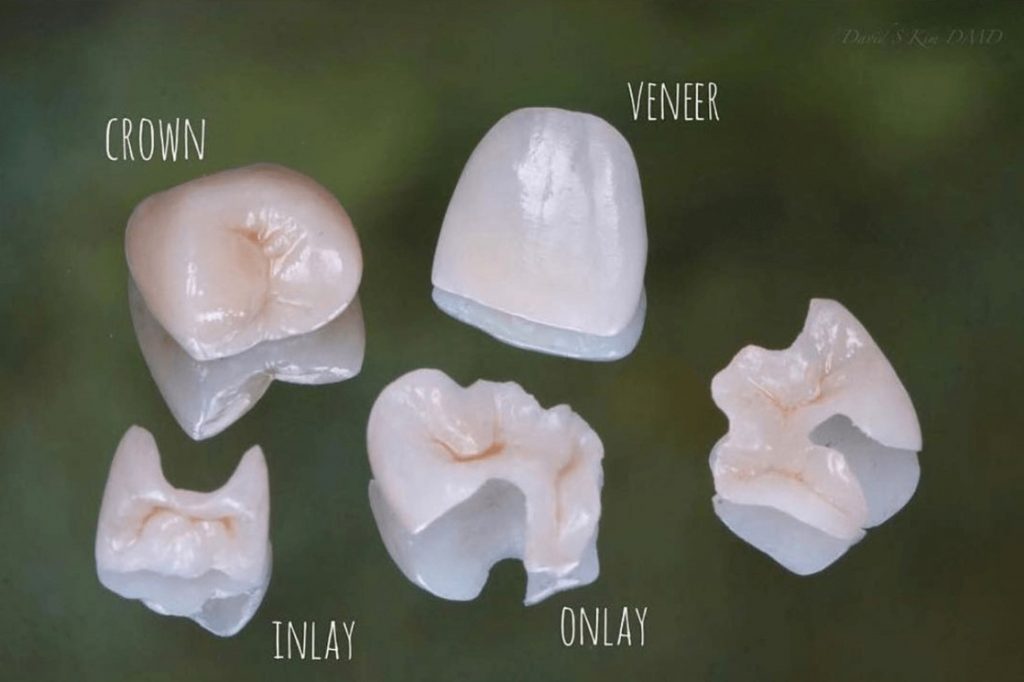
- Inlays and Onlays differ in terms of the area where they are applied and the size of the decay. The main difference can be summarized as follows:
- Inlay filling is applied from tooth tissue lost at a degree that does not involve the crests of the tooth. It may be possible to cover the decay with regular filling method, but it is preferred due to advantages.
- The Inlay is specially produced according to the structure of the tooth and the size of the decay and placed inside the tooth.
- Onley filling, on the other hand, is a bit more similar to a crown coating and is used for caries on the upper part of the tooth. Usually, they are large fillings.
- Like inlay fillings, onlay fillings are specially designed according to the structure of the tooth and the size of the decay.
How to Make Inlay and Onlay Filling?
Inlay and Onlay fillings are made using very similar processes to crown coating. However, in the construction of these fillings, there is no need to shape the tooth structure as much as crown application.
Since the main purpose of the dentist is to preserve the natural tooth structure as much as possible, crown application is preferred in cases where inlay and onlay fillings are insufficient.
The inlay and onlay procedure works like this:
- As in regular fillings, the area around the tooth is anesthetized first and the areas where tooth decay occurs are cleaned.
- Then, using digital modeling or a materials like paste, the tooth will be molded and sent to the dental laboratory.
- After the tooth model is created, inlays and onlays are obtained by using ceramic or resin.
- A temporary filling is applied until the permanent material arrives from the laboratory.
- It can be finished in a single session. If two sessions are required, this temporary filling is removed at the second appointment and a permanent inlay or onlay will be placed.
Advantages of Inlays and Onlays
- It is full ceramic and gives aesthetically successful results.
- Inlays and Onlays are strong, long-lasting materials.
- They do not need more care you will do to your natural teeth. Daily brushing and flossing is enough.
- Natural tooth tissue is preserved as much as possible.
- Inlays and Onlays do not shrink over time like other fillings.
- In terms of abrasion value, the composite is more resistant.
- It is used for many years when proper oral care is done.
- It is one of the frequently preferred methods in aesthetic dentistry.
Onlay or Crown?
Both onlays and crowns contains larger restorations than regular fillings and inlays. While onlay filling is produced to cover only the decaying part of the tooth, crowns are materials that cover the entire outer surface of the tooth.
In addition to less intervention tooth structure, it is also more cost-effective than crown veneers. Therefore, if possible, onlay is a more preferred treatment method.
Your dentist will decide which treatment method your decay is suitable for. Onlay filling is a treatment that is more difficult to apply than a crown and requires a high skill of the dentist.
Clinical and laboratory sensitivity is important. This can be said as the reason why it is expensive than standard fillings.